
The Vicks VapoRub Trick for Lungs: What You Must Know
The Vicks VapoRub trick for lungs uses soothing menthol vapors to provide temporary cough relief and a refreshing sensation of easier breathing.
Vicks VapoRub has been a familiar household remedy for generations, known for its distinctive aroma and cooling sensation during common colds.
Many people use it to ease nighttime coughing, chest discomfort, and breathing-related irritation.
However, Vicks VapoRub does not directly remove mucus from the lungs, clear blocked airways, or repair damaged lung tissue.

The Vicks VapoRub trick for lungs uses soothing menthol vapors to provide temporary cough relief and a refreshing sensation of easier breathing.
Its aromatic ingredients create a sensation of easier breathing without necessarily improving actual airflow.
Understanding the difference between temporary comfort and respiratory treatment is important for safe use.
This article explores how the Vicks VapoRub trick works, its potential benefits, scientific evidence, common misconceptions, and essential safety precautions for supporting respiratory wellness.
What is the Vicks VapoRub Trick for Lungs?
The Vicks VapoRub trick for lungs refers to applying a small amount of the menthol-containing ointment to the chest and throat to provide temporary cough relief during a common cold.
As the ointment releases its distinctive aromatic vapors, users experience a cooling sensation that can make breathing feel more comfortable.
The method is particularly popular before bedtime because coughing and congestion can interfere with sleep.
However, Vicks VapoRub is a topical cough suppressant rather than a treatment that directly enters the lungs or clears mucus from the lower respiratory tract.
Why Do People Use This Trick?
People commonly turn to this remedy for several reasons:
-
Temporary Cough Relief: Helps relieve coughing associated with the common cold.
-
Refreshing Breathing Sensation: Menthol creates a cooling effect that may make nasal airflow feel easier.
-
Nighttime Comfort: The familiar aroma may make cold symptoms feel less bothersome before sleep.
-
Convenient Application: The ointment can be applied externally without preparing a separate remedy.
-
Traditional Cold Care: Many families have used Vicks as part of their home-care routines for decades.
These benefits relate primarily to symptom relief rather than treatment of underlying lung problems.
How Does the Vicks VapoRub Trick for Lungs Work?
Vicks VapoRub contains aromatic compounds that stimulate sensory receptors associated with cooling and irritation.
Its effects involve the nervous system’s interpretation of breathing sensations rather than direct changes in lung structure.
1. Menthol Creates a Cooling Sensation
- Menthol activates temperature-sensitive receptors known as TRPM8 receptors. These receptors help the nervous system detect cooling sensations.
- When menthol vapors reach the nasal passages, they can create a feeling of increased airflow even when the physical dimensions of the airways remain unchanged.
- This explains why some people report easier breathing after applying Vicks.
2. Camphor Contributes to the Aromatic Effect
- Camphor is another active ingredient in Vicks VapoRub. It contributes to the ointment’s characteristic aroma and its labeled topical cough-relieving action.
- However, camphor does not dissolve mucus inside the lungs or reverse respiratory obstruction.
- It must also be handled carefully because swallowing camphor-containing products can cause serious poisoning.
3. Eucalyptus Oil Adds a Distinctive Vapor
- Eucalyptus oil contributes to the recognizable scent of Vicks VapoRub. Its aroma complements the cooling sensations produced by menthol.
- Although eucalyptus compounds have been investigated for various biological properties, applying Vicks does not establish a treatment effect for lung infections or chronic respiratory diseases.
4. Aromatic Vapors Influence Breathing Perception
- The combination of menthol, camphor, and eucalyptus oil creates a strong aromatic experience.
- These vapors can make breathing feel more refreshing while the ointment provides temporary relief from common-cold coughing.
- However, a sensation of clearer breathing does not necessarily mean that mucus has been removed or that narrowed airways have opened.
Active Ingredients in Vicks VapoRub
The standard U.S. Vicks VapoRub formulation contains three principal active ingredients.
| Active ingredient | Concentration | Primary role |
|---|---|---|
| Camphor | 4.8% | Contributes to topical cough relief |
| Eucalyptus Oil | 1.2% | Provides aromatic vapors |
| Menthol | 2.6% | Produces a cooling sensation and contributes to cough relief |
These concentrations refer to the standard U.S. formulation; product labels may differ between countries.
The ointment also contains inactive ingredients that help provide its texture, scent, and topical application properties.
5 Potential Benefits of the Vicks VapoRub Trick for Lungs
1. Provides Temporary Relief From Common-Cold Coughing
One of the most established uses of Vicks VapoRub is temporary relief from coughing associated with the common cold.
Applying it to the chest and throat as directed allows its aromatic vapors to be inhaled during normal breathing.
This may reduce the discomfort associated with nighttime coughing.
However, persistent coughing caused by asthma, pneumonia, or other respiratory diseases requires appropriate medical evaluation.
2. Creates a Sensation of Easier Breathing
Menthol stimulates cooling receptors in the nasal passages, creating a refreshing sensation.
For individuals experiencing nasal congestion, this may make breathing feel less uncomfortable.
Importantly, this sensory effect should not be confused with measurable improvements in lung capacity or airway diameter.
3. May Improve Nighttime Cold Symptom Comfort
Coughing and congestion frequently become more noticeable when lying down.
A clinical study involving children with upper respiratory infections found that vapor rub use was associated with improved parent-reported nighttime cough symptoms and sleep compared with certain comparison conditions.
The findings support a potential role in nighttime symptom comfort, although the study relied on subjective reports and had limitations.
4. Offers a Convenient External Application
Vicks VapoRub can be incorporated into a cold-care routine without swallowing medication.
For eligible adults and children aged two years and older, the product can be applied externally to the chest and throat according to label directions.
External application does not eliminate the possibility of irritation or other adverse effects, so correct use remains important.
5. Complements Other Supportive Cold-Care Measures
Vicks may be used alongside appropriate supportive measures such as hydration, rest, and maintaining comfortable indoor humidity.
These approaches address different aspects of cold-related discomfort.
Vicks should remain a supplementary symptom-relief option rather than a substitute for necessary medical treatment.
How to Use the Vicks VapoRub Trick for Lungs Safely
The Vicks VapoRub trick for lungs involves applying the ointment to the chest and throat to help temporarily relieve coughing associated with the common cold.
Its menthol, camphor, and eucalyptus oil vapors create a cooling sensation that may make breathing feel more comfortable.
Step 1: Apply Vicks to the Chest and Throat
🔹Gently rub a thick layer of Vicks VapoRub onto the chest and throat as directed on the product label. This allows the aromatic vapors to be inhaled naturally during breathing.
Step 2: Wear Loose Clothing
🔹Keep clothing around the chest and neck loose so the vapors can reach the nose and mouth. Avoid tight coverings, bandages, or applying heat over the ointment.
Step 3: Use Before Bedtime for Cough Relief
🔹Apply Vicks before bedtime when common-cold coughing makes sleeping uncomfortable. Its soothing aroma may provide temporary cough relief and improve nighttime comfort.
Step 4: Follow the Recommended Usage
🔹For adults and children aged two years and older, Vicks VapoRub may be applied up to three times daily for cough relief, according to the standard U.S. product label.
Important Safety Precautions
- Do not apply Vicks inside the nostrils, mouth, or eyes.
- Never swallow Vicks VapoRub or mix it with hot water.
- Do not use it on children younger than two years.
- Avoid applying it to damaged, irritated, or broken skin.
Consult a healthcare professional if coughing persists for more than seven days, returns, or occurs with fever, rash, or persistent headache.
Can Vicks VapoRub Remove Mucus From the Lungs?
One of the most common claims surrounding the Vicks VapoRub trick is that its vapors can loosen and remove mucus trapped deep inside the lungs.
However, there is no convincing clinical evidence that applying Vicks to the chest directly dissolves mucus in the lower respiratory tract.
Mucus serves an important protective function in the respiratory system. It traps dust, microorganisms, and other particles before they reach delicate lung tissue.
Tiny hairlike structures called cilia help move mucus upward through the airways, where it can be swallowed or expelled through coughing.
Vicks VapoRub does not replace or significantly accelerate this natural lung-cleaning mechanism.
Although its aromatic vapors may make breathing feel more comfortable, this does not mean that accumulated mucus has physically disappeared.
People experiencing persistent thick mucus, unusual sputum, or a worsening productive cough should seek medical advice rather than relying on chest rubs alone.
Does Vicks VapoRub Help With COPD, Asthma, or Bronchitis?
People with chronic respiratory conditions sometimes explore the Vicks VapoRub trick for lungs as a way to manage coughing or breathing discomfort.
However, the usefulness and safety of this approach depend on the underlying condition.
| Respiratory condition | What Vicks may do | Important limitation |
|---|---|---|
| Common cold | Temporarily relieve associated coughing | Does not cure the viral infection |
| COPD | May produce a cooling breathing sensation | Does not reverse airflow obstruction or treat COPD |
| Asthma | May create a subjective sensation of freshness | Strong fragrances may trigger irritation or symptoms |
| Bronchitis | May provide limited comfort for cold-related coughing | Does not treat the underlying inflammation or infection |
| Pneumonia | No established treatment benefit | Requires appropriate medical assessment |
| Lung fibrosis | No established therapeutic benefit | Cannot reverse lung scarring |
People with asthma, emphysema, or persistent chronic coughing should consult a healthcare professional before using Vicks for cough relief.
What Does Science Say About the Vicks VapoRub Trick?
Scientific research provides some support for temporary nighttime symptom relief, but not for claims that Vicks cleanses or repairs the lungs.
Research on Nighttime Cough Relief
A 2010 study published in Pediatrics examined vapor rub, petroleum jelly, and no treatment among 138 children aged two to eleven with upper respiratory infections.
Parents reported greater improvements in nighttime coughing, congestion, and sleep difficulties in the vapor rub group.
However, the study also found more mild irritant effects among children receiving vapor rub.
The results suggest that the product may offer short-term comfort, but they do not establish effectiveness against chronic respiratory diseases.
Research on Menthol and Airflow
A separate study examining menthol’s effects on nasal airflow found that participants often experienced a greater sensation of openness after menthol exposure.
Nevertheless, objective measurements did not demonstrate consistent reductions in nasal airflow resistance.
This distinction helps explain why menthol-containing products can feel effective without physically opening blocked nasal passages.
Overall, the scientific evidence supports a limited role for Vicks in relieving certain common-cold symptoms rather than improving lung function.
5 Common Myths About the Vicks VapoRub Trick for Lungs
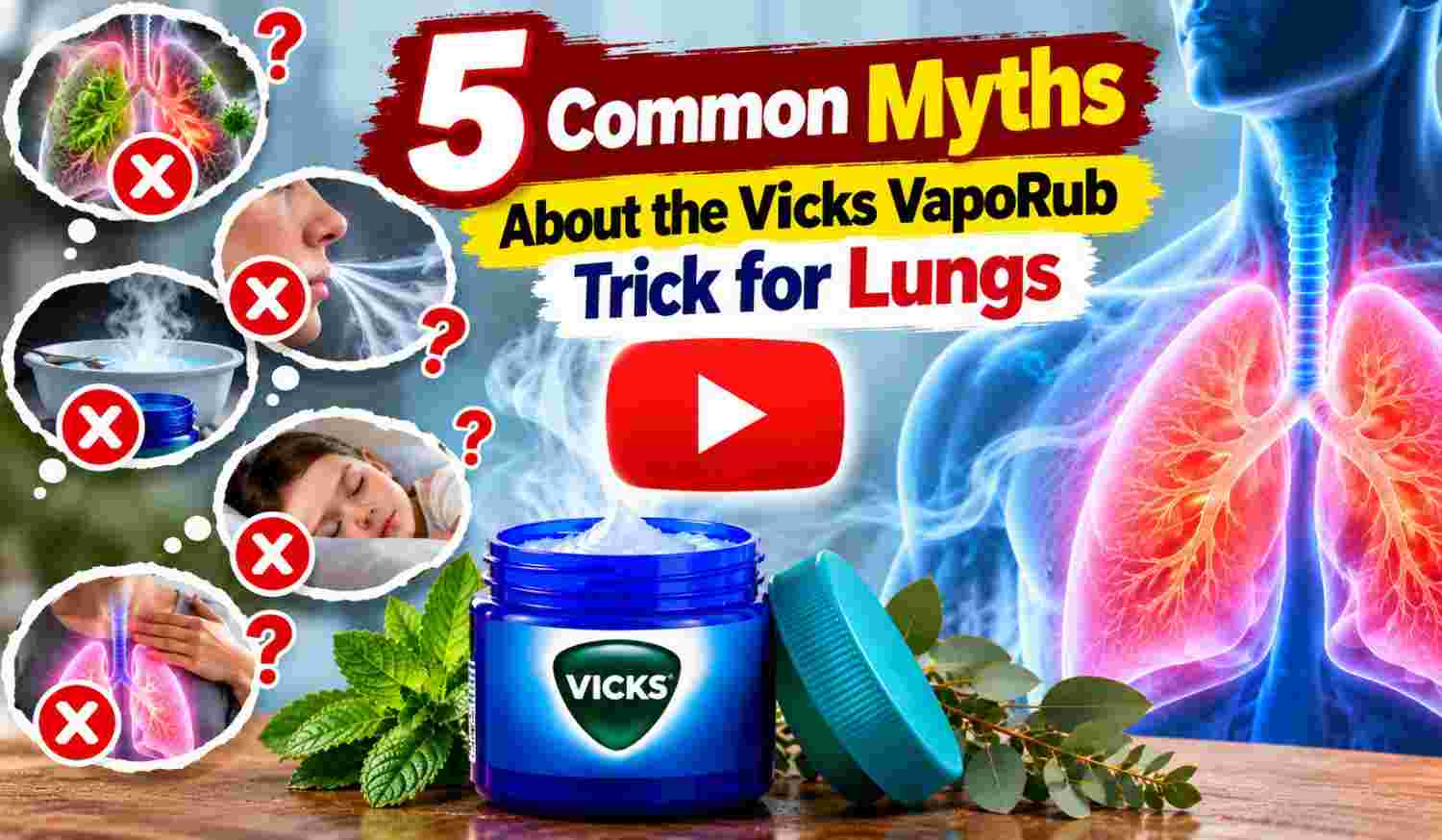

Myth 1: Vicks Completely Cleanses the Lungs
- The lungs naturally clear inhaled particles through mucus production, ciliary movement, and immune defenses.
- There is no established evidence that applying Vicks removes accumulated toxins or pollutants from lung tissue.
Myth 2: Vicks Opens Blocked Airways
- Menthol may make nasal breathing feel easier, but this does not prove that narrowed airways have physically widened.
- Vicks is not a substitute for prescribed bronchodilator medications.
Myth 3: Applying More Vicks Produces Better Results
- Using excessive amounts does not guarantee stronger cough relief.
- Following the recommended application instructions is safer than repeatedly applying large quantities.
Myth 4: Vicks Can Treat Lung Infections
- Vicks does not replace antibiotics when indicated, antiviral treatments, or other medical care for respiratory infections.
- Its primary purpose is temporary symptom relief.
Myth 5: Vicks Is Safe for Everyone Because It Is Applied Externally
- Topical products can still cause irritation, allergic reactions, and accidental poisoning.
- Vicks should not be used on children younger than two years, and it must never be swallowed.
Possible Side Effects and Safety Precautions
Although many people tolerate Vicks VapoRub when used as directed, unwanted reactions can occur.
Possible problems include:
-
Skin Irritation: Redness, burning, or discomfort at the application site.
-
Eye Irritation: Strong vapors or accidental contact may irritate sensitive eyes.
-
Respiratory Sensitivity: Fragrances may aggravate symptoms in susceptible individuals.
-
Allergic Reactions: Certain ingredients may trigger skin or respiratory reactions.
-
Camphor Poisoning: Accidental ingestion can cause serious toxicity, including seizures.
People with a cough accompanied by excessive mucus or a chronic cough associated with smoking, asthma, or emphysema should consult a clinician before using the product.
Other Ways to Support Respiratory Comfort
While Vicks may help relieve certain cold symptoms, several additional approaches can support comfort and normal respiratory function.
Stay Hydrated: Drinking adequate fluids supports normal mucus consistency and helps prevent dehydration during illness.
Use Saline Nasal Sprays: Saline products may help moisturize nasal passages and reduce discomfort associated with nasal congestion.
Maintain Comfortable Indoor Humidity: A clean, properly maintained cool-mist humidifier may help relieve dryness in the nose and throat.
Avoid Smoke and Airborne Irritants: Cigarette smoke, dust, and strong fragrances can aggravate respiratory symptoms.
Get Adequate Rest: Sleep supports immune function and recovery during common respiratory infections.
For a cough that persists, worsens, or is accompanied by concerning symptoms, professional evaluation is more appropriate than repeated home treatment.
Final Thoughts: Is the Vicks VapoRub Trick for Lungs Worth Trying?
The Vicks VapoRub trick for lungs is a familiar home-care method that may offer temporary relief from common-cold coughing and provide a refreshing breathing sensation.
Its combination of menthol, camphor, and eucalyptus oil produces aromatic vapors that influence sensory perception and may improve nighttime comfort.
However, Vicks does not remove deep lung mucus, repair damaged respiratory tissue, reverse chronic airway obstruction, or treat serious lung diseases.
For adults and children aged two years and older, using the ointment according to its label can be a reasonable part of a short-term cold-care routine.
The key is understanding its purpose: Vicks VapoRub may help you feel more comfortable while recovering from a common cold, but it is not a treatment for underlying lung disease.
Seek urgent medical care for severe breathing difficulty, blue or gray lips, chest pain, or other signs of serious illness.
.
.
.
.
.
References
- https://www.mayoclinic.org/diseases-conditions/common-cold/expert-answers/nasal-decongestant
- https://www.healthline.com/health/vicks-vaporub-benefits?utm_source=chatgpt.com
- https://www.webmd.com/drugs/otc-brands/vicks-vapo-cough-cold-flu
.
.
.