
What Does Sermorelin Do? Benefits and How It Works
Nuvectra Medical · Hormone Health Guide
What Does Sermorelin Do? How It Works, and What to Know Before You Consider It
It is marketed as a “natural” way to boost growth hormone. Here is what sermorelin really does in the body, what it was approved for, where the research falls short, and the questions worth asking a doctor.
The quick answer
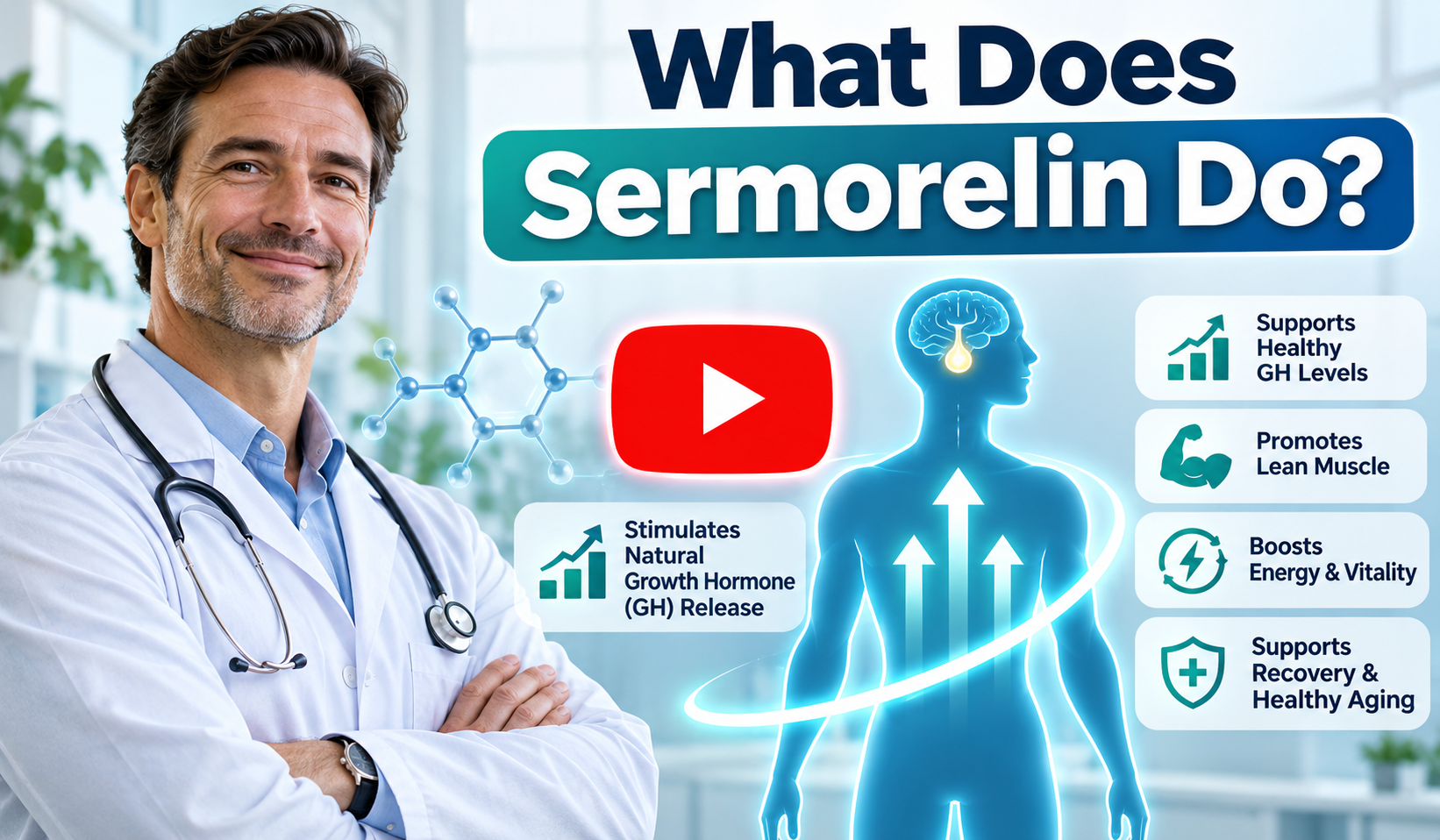
Sermorelin is a synthetic version of the first 29 amino acids of growth hormone-releasing hormone (GHRH). It signals the pituitary gland to release the body’s own growth hormone.
Scroll through social media or browse a wellness clinic’s menu and you will probably run into sermorelin. It is described as a gentler cousin of growth hormone that can restore energy, deepen sleep, trim belly fat and help you recover faster. The claims are bold, and the product has a real medical history, which makes it sound more established than it is.
So what does sermorelin do, exactly? This guide separates the science from the sales pitch. We explain how it works, what it was originally approved for, what people hope it will do, what the evidence says about those hopes, the side effects and risks, and what to ask a healthcare provider if you are curious.

What Is Sermorelin?
Your hypothalamus, a small region at the base of the brain, makes a hormone called growth hormone-releasing hormone, or GHRH. GHRH travels to the pituitary gland and tells it to release growth hormone (GH) into the bloodstream. GH then helps drive growth in children and, in adults, plays a role in body composition, bone, muscle and metabolism.
Natural GHRH is 44 amino acids long. Research
ers found that the first 29 carry essentially all of its activity. That shortened fragment, GHRH(1-29), is sermorelin. It is a peptide, meaning a short chain of amino acids, and it is given by injection under the skin.
Sermorelin is not growth hormone
This is the single most misunderstood point. Recombinant human growth hormone (somatropin) is the hormone itself. Sermorelin is the signal that asks your pituitary to make its own. That difference shapes both its potential benefits and its risks.
How Does Sermorelin Work in the Body?
Sermorelin binds to GHRH receptors on cells in the front of the pituitary gland, mimicking your natural GHRH. The pituitary responds by releasing growth hormone in pulses, much as it does in the body’s normal rhythm. GH then travels to the liver and other tissues, where it prompts production of insulin-like growth factor 1 (IGF-1), the compound that carries out many of GH’s effects. Doctors often measure IGF-1 in the blood as a marker of GH activity.
Because sermorelin works upstream, the pituitary is still subject to the body’s own brakes. When GH and IGF-1 rise, the body releases somatostatin, a hormone that dampens further GH release. In theory, this feedback loop makes it harder to overshoot to very high levels than when injecting GH directly. That is a genuine pharmacological difference and the main reason sermorelin is called “more physiological.” However, no long-term trial in healthy adults has shown that this theoretical advantage translates into fewer adverse outcomes.
Another practical detail: sermorelin is cleared from the body very quickly, with a half-life measured in minutes. Its effect is a short signal to the pituitary, not a long-lasting change.
Growth hormone levels naturally decline with age, and GH release tends to be strongest during deep sleep. The idea behind sermorelin for adults is that giving the pituitary a boost might partly restore youthful GH patterns. It is a reasonable hypothesis, but a hypothesis is different from proven benefit.
👉 DON’T TRY THIS “ SERMORELIN” UNTIL YOU SEE THIS
What Was Sermorelin Originally Approved For?
Sermorelin has a real regulatory history, which is part of why it carries credibility. In the United States it was sold under the brand name Geref. A diagnostic version was approved in 1990 to test how well the pituitary can secrete growth hormone. In 1997 the FDA approved an injectable version to treat children with idiopathic growth hormone deficiency and slow growth.
| Year | Milestone |
|---|---|
| 1990 | Approved as a diagnostic test of pituitary growth hormone reserve |
| 1997 | Approved for children with idiopathic growth hormone deficiency and growth failure |
| 2008 | Manufacturer discontinues the product |
| 2013 | FDA determines Geref was not withdrawn for reasons of safety or effectiveness |
Two points are worth holding together. First, the FDA concluded that Geref was not pulled over safety or effectiveness concerns. Its maker simply stopped producing it, partly because recombinant growth hormone became the standard for children. Second, neither approval had anything to do with aging, adult body composition, sleep quality or athletic recovery. Those uses came later, through compounding pharmacies and wellness clinics.
Today there is no FDA-approved sermorelin product on the U.S. market. A related GHRH analog, tesamorelin, is approved for one narrow purpose: reducing excess abdominal fat in adults with HIV-associated lipodystrophy. It is a different drug in a different population, and its results should not be assumed to apply to sermorelin.
What Do People Use Sermorelin For Today?
Clinics and telehealth platforms that offer compounded sermorelin generally pitch it for adults who feel their energy and physique are slipping with age. The commonly advertised goals are listed below, along with an honest read on the evidence for each.
Raising GH and IGF-1
Evidence: strongest. This is what sermorelin demonstrably does. It reliably stimulates the pituitary to release GH.
Childhood growth problems
Evidence: solid, but historical. Trials in children supported its original approval, though recombinant GH has largely replaced it.
Fat loss and muscle
Evidence: weak. Pooled research on raising GH in healthy older adults shows only small changes in lean mass and fat, with no gain in strength.
Better sleep
Evidence: mostly anecdotal. GHRH has sleep-related effects in some controlled studies, but sermorelin-specific proof in healthy adults is thin.
Energy and mood
Evidence: weak. Reports are largely personal experiences, and placebo effects are hard to rule out.
Anti-aging and recovery
Evidence: not established. No GHRH analog or growth hormone therapy is approved for anti-aging, and major medical groups do not recommend it for that purpose.
What Does the Research Actually Show?
The honest summary is that sermorelin does raise growth hormone, but that is not the same as improving health in a healthy adult. Several things are worth knowing.
The best sermorelin studies were done in children with documented growth hormone deficiency. For adults, the evidence is mostly small, short or uncontrolled studies. When articles describe fat loss and muscle benefits, they often lean on research into tesamorelin or into growth hormone itself, not sermorelin.
Raising GH in healthy older adults has a mixed track record
A widely cited systematic review of growth hormone in healthy older adults found modest changes in body composition, no meaningful strength gains, and more side effects such as swelling, joint pain and blood sugar problems. The Endocrine Society’s 2023 scientific statement on hormones and aging concluded that no GHRH analog or GH therapy is approved for anti-aging and that growth hormone cannot be recommended for that purpose. Sermorelin acts on the same pathway, so these cautions carry weight even though sermorelin is a different molecule.
The “safer than HGH” claim is still theoretical
The somatostatin feedback loop is a plausible safety advantage. But plausible is not proven. No long-term trial has demonstrated that sermorelin leads to fewer adverse events than growth hormone in healthy adults.
Before-and-after stories are not evidence
Many people report feeling better on sermorelin. That experience is real to them, but without controlled comparisons it is impossible to separate the drug from placebo effects, better sleep habits, new exercise routines or simply the attention of a clinic.

Sermorelin Side Effects and Risks
Reported side effects are usually mild, but they are not zero, and the long-term picture in healthy adults is not well mapped.
Common side effects
The most frequent complaint is a reaction at the injection site: pain, redness or swelling. Others include flushing, headache, dizziness, nausea and, occasionally, sleepiness or restlessness.
Risks linked to too much growth hormone
Because sermorelin raises GH and IGF-1, sustained high levels could cause fluid retention, joint pain, carpal tunnel symptoms and changes in how the body handles blood sugar. These effects are documented mainly with growth hormone itself, but the same pathway is involved.
Cancer considerations
Growth hormone and IGF-1 promote cell growth, so active cancer or a history of cancer is an important reason for caution and for a conversation with your doctor.
Allergic reactions
As with any injectable, rash, hives, swelling of the face or throat, or trouble breathing need emergency care.
Side effects can be reported to the FDA through its MedWatch program.
The Compounding Problem: Why Quality and Legality Matter
Because there is no approved sermorelin product, anyone using it today receives a compounded preparation made by a pharmacy for an individual prescription. That has several implications.
- Compounded drugs are not FDA-approved. The FDA does not verify their safety, effectiveness or quality the way it does for approved medicines.
- This is not “off-label” use of an approved drug. It is the use of a compounded preparation with no current approval behind it.
- Regulatory status can shift. Regulators have been reviewing which bulk peptides may be compounded, and sermorelin’s status has been described as under evaluation rather than settled.
- Source matters. Products offered without a real prescription and clinical evaluation are a red flag, not a shortcut.
- Athletes beware. Sermorelin appears on the World Anti-Doping Agency’s prohibited list.
👉 DON’T TRY THIS “ SERMORELIN” UNTIL YOU SEE THIS
Who Should Be Especially Careful?
Sermorelin is not appropriate for everyone, and several groups need a doctor’s guidance before even considering it:
- People with a current or past cancer diagnosis
- People with diabetes or prediabetes, since GH affects blood sugar
- Anyone who is pregnant or breastfeeding
- People with thyroid disease or other untreated hormone problems
- Anyone allergic to sermorelin or its components
- Competitive athletes subject to drug testing
Feeling Tired, Soft, or Slow? Look for Treatable Causes First
Many people who are drawn to sermorelin are really trying to solve a problem: low energy, poor sleep, stubborn weight, slow recovery. Those problems have many causes, and several have well-established treatments. A healthcare provider can check for:
Under- or overactive thyroid
Including sleep apnea
Or other sex-hormone changes
Such as vitamin D or B12
Insulin resistance, diabetes
Which can mimic hormone problems
Lifestyle basics also move the needle: regular resistance training, enough protein, consistent sleep, limiting alcohol, and managing stress. None is glamorous, but they have far better evidence than any peptide for healthy adults.
Questions to Ask a Provider Before Considering Sermorelin
- What is my diagnosis? Do I have documented growth hormone deficiency, or am I treating general aging symptoms?
- What tests do you recommend first? Hormone panels, blood sugar, thyroid and a medication review are common starting points.
- Where does the product come from? Is it from a licensed compounding pharmacy, and with what quality testing?
- How will we monitor safety? Ask about IGF-1 and glucose checks and how often.
- What results are realistic, and when will we stop? A clear plan for judging success keeps therapy from drifting on indefinitely.
- What are the alternatives? Ask what treats my specific symptoms with stronger evidence.
Frequently Asked Questions
What does sermorelin do in simple terms?
It mimics your body’s own growth hormone-releasing hormone, prompting the pituitary gland to release more growth hormone. It does not supply growth hormone directly.
Is sermorelin the same as HGH?
No. HGH is the hormone itself. Sermorelin is a signal that encourages your pituitary to make its own, and your body’s feedback system can limit how high levels go.
Is sermorelin FDA-approved?
It was approved in the past for childhood growth hormone deficiency and as a diagnostic test, but that product was discontinued. No sermorelin product is currently FDA-approved, and compounded versions are not evaluated by the FDA.
Was sermorelin taken off the market because it was unsafe?
No. The FDA determined that Geref was not withdrawn for safety or effectiveness reasons. The manufacturer discontinued it for business reasons.
Does sermorelin help with weight loss or muscle gain?
There is no good-quality evidence that it builds muscle or reduces body fat in healthy adults. Claims rest largely on anecdotes and on research into related drugs.
How is sermorelin given?
Injection under the skin is the standard and best-studied route. Some pharmacies offer other forms, but these have less evidence behind them. Dosing should only be set by a prescribing clinician.
Can I take sermorelin without a prescription?
It should not be used that way. Legitimate access requires a clinical evaluation and a patient-specific prescription. A seller offering it with no medical oversight is a warning sign.
The Bottom Line
So, what does sermorelin do? It nudges your pituitary gland to release more of your own growth hormone, which in turn raises IGF-1. That much is well established, and it is why sermorelin once had a legitimate role in diagnosing and treating growth hormone deficiency in children.
What it does not have is strong proof that boosting GH this way makes healthy adults younger, leaner, stronger or better rested. Today it is a compounded, unapproved product, its adult uses rest on limited evidence, and its long-term safety in healthy people is not established. If you are curious, the smartest move is not to buy a vial but to book a visit: find out why you feel the way you do, treat the causes that have proven treatments, and let a qualified clinician tell you honestly whether sermorelin belongs in your plan at all.
Wondering about hormone health?
Talk to a qualified healthcare provider before starting any hormone-related therapy.
References
- U.S. Food and Drug Administration. “Determination That GEREF (Sermorelin Acetate) Injection… Were Not Withdrawn From Sale for Reasons of Safety or Effectiveness.” Federal Register, March 4, 2013. https://www.govinfo.gov/content/pkg/FR-2013-03-04/html/2013-04827.htm
- “Sermorelin.” Healthline. https://www.healthline.com/health/sermorelin.html
- “Sermorelin Quick Guide.” Testing.com. https://www.testing.com/?p=46416
- “Sermorelin for anti-aging: evidence, risks and monitoring.” Testing.com. https://www.testing.com/?p=47222
- “Sermorelin: What the Evidence Shows.” Healthy Male (Andrology Australia). https://healthymale.org.au/health-article/sermorelin-what-the-evidence-shows