
Vicks VapoRub Trick for Lungs: Does It Really Work?
Nuvectra Medical · Wellness Guide
Vicks VapoRub Trick for Lungs: Does It Really Work?
Rub it on your chest, your feet, or in your nose? Here is what the science says about the popular “lung trick,” how to use VapoRub safely, and what actually helps a cough.
The quick answer
VapoRub is a comfort product, not a lung treatment. It may ease the feeling of congestion and nighttime coughing from a common cold, but it will not fix a chest infection, and it should never go inside your nose, in a child under two, or into a pot of boiling water.
You have probably seen the video. Someone with a cough scoops a thick layer of Vicks VapoRub onto their chest, covers up with a blanket, and promises that the “lung trick” cleared everything out overnight. Some versions have you rub it on your feet and pull on socks. Others have you melt it in hot water and breathe the steam. A few even say to dab it inside your nose.
It is a tempting idea. VapoRub has been sitting in medicine cabinets for well over a century, it smells like childhood sick days, and it costs a few dollars. If it could really clear your lungs, it would be a bargain. So does the Vicks VapoRub trick for lungs really work, or is it just a very good-smelling myth?

The honest answer sits somewhere in the middle. VapoRub can make a cold feel more bearable, and there is some real research behind that. But it does not clear your lungs, it does not fight infection, and a few of the popular “tricks” are actually unsafe. In this guide, we will walk through what the science says, what the jar’s own label allows, and when it is time to put the ointment down and call a doctor.
The Short Answer: Does Vicks VapoRub Clear Your Lungs?
No. Vicks VapoRub does not clear mucus from your lungs, open your bronchial tubes, kill viruses, or treat pneumonia or bronchitis. What it can do is change how your cold feels, mainly through the cooling effect of menthol on nerves in your nose and skin. That can make breathing feel easier and help some people, especially children over two, rest better at night.
👉 DON’T TRY THIS “VICKS VAPORUB TRICK FOR LUNGS” UNTIL YOU SEE THIS
What Is Actually in a Jar of Vicks VapoRub?
To judge any claim about VapoRub, it helps to know what is in the jar. The classic US formula has three active ingredients in a petroleum-based ointment: camphor at about 4.8 percent, menthol at about 2.6 percent, and eucalyptus oil at about 1.2 percent. The rest of the jar is made up of petrolatum along with cedarleaf oil, nutmeg oil, thymol, and turpentine oil.
| Menthol | is the star of the show for congestion. It is the compound that gives mint its cooling kick and it is the main reason VapoRub feels like a breath of fresh air. |
| Camphor | acts as a mild topical analgesic and cough suppressant. It is also the ingredient that makes VapoRub dangerous if swallowed or used the wrong way. |
| Eucalyptus oil | adds the strong, herbal scent. It contributes to the “clear head” sensation, although the smell itself does not open anything up. |
| Petrolatum | is the base. It holds the active ingredients on your skin and keeps them from evaporating too quickly. |
None of these ingredients is a decongestant in the pharmacological sense. Real decongestants, such as pseudoephedrine, work by narrowing swollen blood vessels in the lining of the nose. Menthol does not do that. That single fact explains most of what follows.
How VapoRub Works: The Menthol Illusion
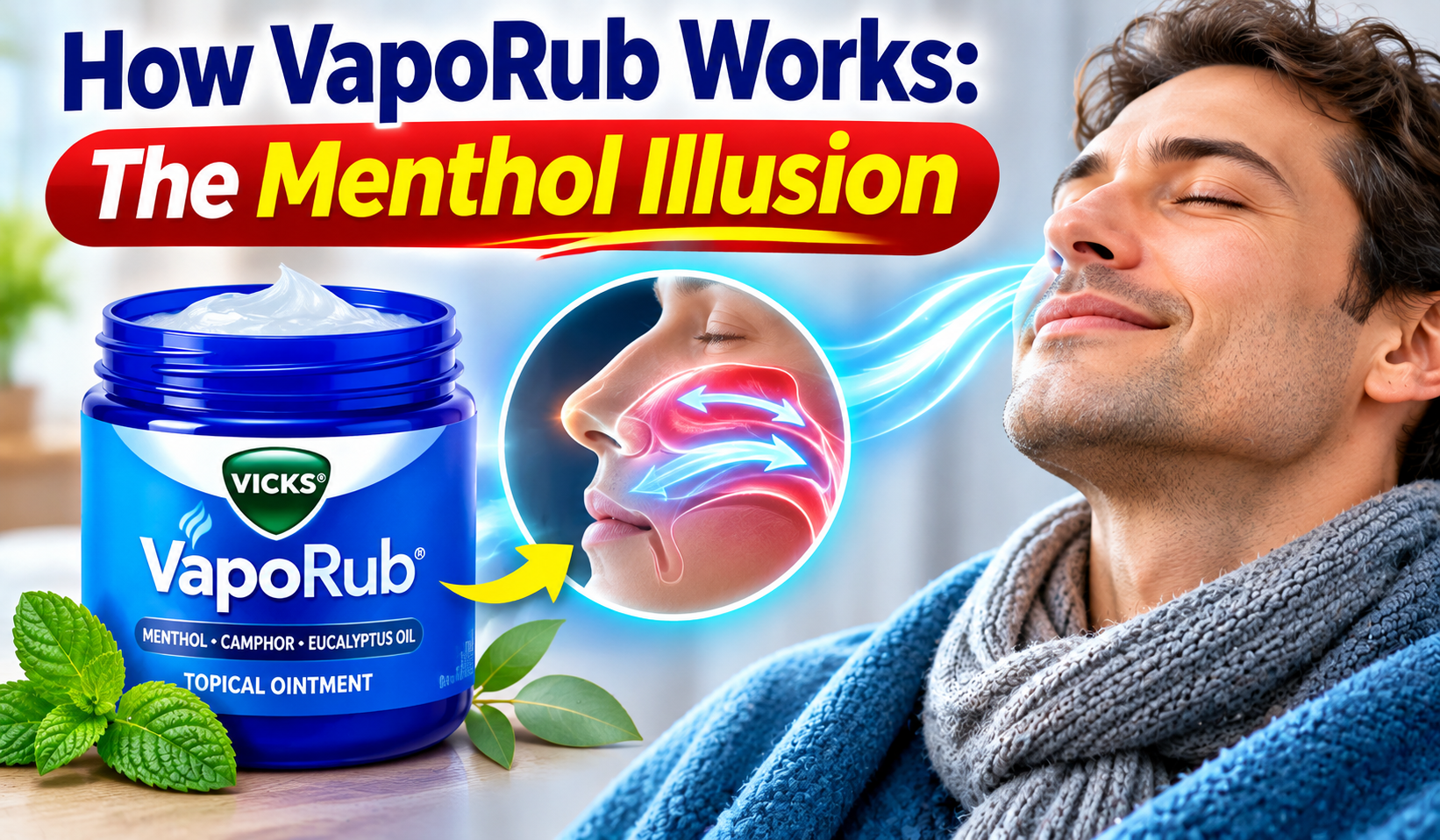
When you smell menthol or feel it on your skin, it activates a cold-sensitive receptor called TRPM8 on sensory nerves. Your brain reads this as cool air moving through your nose. Since we judge how open our nose is largely by how much cool air we feel flowing, that cooling signal can make your nose feel clearer even when nothing physical has changed.
Researchers have tested this idea for decades, and the results are surprisingly consistent. In one double-blind trial of people with common cold congestion, a menthol lozenge produced a marked improvement in the sensation of airflow, yet measurements of the actual resistance to airflow in the nose did not change compared with placebo. A later study of healthy volunteers found that breathing menthol vapor did not change nasal airflow or the temperature of the nasal lining, even though most participants said their breathing felt better.
Other work has shown that the effect is specific to one form of menthol, l-menthol, and not to look-alike compounds with a similar minty smell. That points to a true biological action on nerve endings rather than just a pleasant scent. In plain terms, VapoRub is not fooling you with a fragrance. It is genuinely stimulating nerves in a way that changes how breathing feels. It just is not changing how much air actually gets through.
This matters because “feels easier to breathe” and “opens the airways” are two very different claims. The first has support. The second does not.
What the Research Says About Coughs and Sleep
If menthol only changes sensation, is VapoRub just a placebo? Not entirely. The best-known human trial of VapoRub was published in the journal Pediatrics in 2010 by researchers at Penn State. They recruited 138 children between the ages of 2 and 11 who had cold symptoms and compared a single bedtime application of vapor rub with plain petroleum jelly and with no treatment at all.
Parents rated the vapor rub group best for nighttime cough, congestion, and how well their child slept. Parents in the vapor rub group also reported better sleep for themselves. Plain petroleum jelly landed in the middle, and doing nothing came in last. Mild skin irritation was more common with VapoRub, but it was generally minor.
That sounds like a win, and it is a real finding. But it is worth reading it with a clear head. The study was small, it relied on parent ratings rather than objective measurements, and the strong smell of VapoRub made it hard to keep parents truly unaware of which product they were using. Some pediatricians who reviewed the study also pointed out that the lead researcher had ties to the manufacturer. A pharmacist commenting on the results noted that the benefit for cough frequency and severity over petroleum jelly was only marginal, and that VapoRub was no better for congestion or runny nose than the comparison group.
The fair summary is this: there is modest evidence that VapoRub can improve nighttime comfort and sleep during a cold in children over two. There is no evidence that it shortens the illness, clears the chest, or treats any underlying lung problem. Cough research is also notoriously affected by the placebo effect, which makes any home remedy hard to evaluate. Even so, a better night’s sleep for a sick child and a tired parent is not nothing.
Breaking Down the Viral “Lung Tricks”
Social media has turned VapoRub into a Swiss Army knife. Let us go through the most popular tricks one by one.
Trick 1: Rub It on Your Chest to Clear Your Lungs
This is the original and the only one that matches the label. Applying a thick layer to the chest and throat, and keeping clothing loose so vapors can reach your nose and mouth, is exactly what the directions say for cough suppression. The part that is not supported is the “clear your lungs” claim. The vapors drift up toward your nose. They do not travel down and dissolve mucus in the lower airways. If you have a cough that feels deep or heavy, VapoRub is at best a comfort measure for symptoms, not a treatment for the cause.
Trick 2: Put It on Your Feet and Wear Socks
This trend suggests that applying VapoRub to the soles of the feet stops a cough through some kind of nerve pathway. There is no good evidence that it does. Medical and pharmacy resources that have looked at the idea report no support for relieving cold, congestion, or cough this way. The ointment may soften dry heels, and some people use it on toenails, but it is not a cough treatment on your feet. Since the cooling vapors are what people are noticing, applying it far from your nose also removes the one mechanism that has any support.
Trick 3: Put It Inside Your Nose
Please do not do this. The label specifically says not to use VapoRub in the nostrils. Camphor can be absorbed through the delicate lining inside the nose, and camphor toxicity can cause serious problems, including seizures. Petroleum-based products in the nose can also be inhaled in tiny amounts over time. A published case report described an 85-year-old woman who developed a lung condition called exogenous lipoid pneumonia after continuously applying VapoRub to her nostrils for chronic stuffiness. Fat-based substances reaching the air sacs of the lungs can trigger inflammation, and older adults and young children are more vulnerable. Ironically, this trick may harm the very lungs it claims to clear.
Trick 4: Melt It in Hot Water and Breathe the Steam
The idea is popular because steam feels soothing, and some product leaflets in other countries describe an inhalation method for adults using hot, not boiling, water. In the US, however, the labeling on VapoRub warns against adding it to hot water or any container used to heat water because it can splatter and cause burns. It also should not be microwaved or exposed to flame. Hot steam by itself has not been shown to treat respiratory infections, and the risk of scalds, especially for kids leaning over a bowl, is real. If you enjoy steamy air, a warm shower or a cool-mist humidifier is a much safer way to get it.
Trick 5: Use It Every Day for Chronic Congestion
VapoRub is made for short-term use during a cold. If your congestion keeps coming back or lasts for weeks, that is a sign to look for the cause rather than add more ointment. Chronic congestion can come from allergies, sinus problems, asthma, reflux, or other conditions that deserve a proper evaluation.
👉 DON’T TRY THIS “VICKS VAPORUB TRICK FOR LUNGS” UNTIL YOU SEE THIS
Viral claims vs. reality at a glance
| Claim | Reality check |
|---|---|
| “Rub it on your chest to clear your lungs” | Partly true. Chest and throat is the labeled use, but it eases cold symptoms. It does not clear mucus from the lungs. |
| “Put it on your feet and wear socks to stop a cough” | No good evidence. Medical sources find no support for it. |
| “Dab it inside your nose to open your airways” | Unsafe. The label says not to use it in the nostrils, and camphor can be absorbed there. |
| “Melt it in hot water and breathe the steam” | Not advised on US labels. Hot water can splatter and cause burns. |
| “VapoRub kills germs and cures chest infections” | False. It changes how symptoms feel and does not treat infection. |
Does the Smell Reach Your Lungs at All?
It helps to picture where the vapors really go. When you rub VapoRub on your chest, body heat warms the ointment and releases aromatic compounds into the air in front of your face. You breathe them in through your nose and mouth. The active ingredients reach your nasal passages and upper throat, where the nerves that sense cold are located. That is where the effect happens.
The ointment itself is not designed to be absorbed deep into your body through the skin to act on lung tissue. Nothing in the evidence suggests that rubbing it on the skin of your chest changes what is happening in your bronchi or alveoli. Think of VapoRub as a signal sent to your nose, not a treatment delivered to your lungs.
Safety First: Who Should Be Careful With Vicks VapoRub
Because it is sold over the counter, VapoRub can seem harmless. It is not harmless when it is used incorrectly, and the risks are highest for young children.
Children Under Two
The label is clear: do not use VapoRub on children under two years old. In a published case, a toddler developed severe respiratory distress after VapoRub was applied directly under her nose. Camphor and menthol near the face of an infant can irritate the airways and slow breathing. If you want a rub for a younger child, ask a pediatrician or pharmacist, because some brands sell camphor-free alternatives, though even those deserve a doctor’s input for babies.
Swallowing and Poisoning
Camphor is toxic when swallowed. US poison centers have recorded roughly ten thousand camphor-product ingestion exposures per year in earlier national data. Keep the jar out of reach and never let a child eat it, even a small amount. If someone swallows VapoRub, call poison control or seek emergency care right away.
Heat, Bandages, and Broken Skin
- Do not heat VapoRub, microwave it, or add it to hot water.
- Do not wrap the area tightly or use it with heating pads.
- Do not apply it to wounds, broken skin, or irritated skin.
- Avoid contact with your eyes. If it gets in, rinse with water.
- Stop using it and see a doctor if irritation develops or symptoms get worse.
Breastfeeding, Asthma, and Chronic Lung Conditions
Medication references advise asking a doctor before using VapoRub if you are pregnant or breastfeeding, and some leaflets say not to use it on the chest of a breastfeeding mother because of the small chance it could affect the baby’s breathing. The US label also advises talking to a doctor if you have a cough with a lot of mucus. If you have asthma, emphysema, or another chronic lung condition, or if you smoke and have a lingering cough, strong aromas can sometimes make breathing worse for sensitive airways, so check with your healthcare provider first.
How to Use Vicks VapoRub the Right Way
If you decide to try it, here is how to use it the way the label intends.
- Confirm that the person using it is two years or older.
- Apply a thick layer to the chest and throat only. Do not put it in or around the nostrils.
- Keep clothing loose around the neck and chest so the vapors can rise.
- You may cover the area with a warm, dry cloth if you like, but do not bandage tightly.
- Repeat no more than three times in 24 hours, or follow your doctor’s directions.
- Wash your hands after applying so you do not transfer it to your eyes.
- Store the jar at room temperature, closed, and away from children.
Many people apply it about 30 minutes before bed, since nighttime is when coughing and stuffiness tend to be worst. Do not heat it first, and do not keep using it for weeks on end.
Better Ways to Ease a Cough and Chest Congestion
VapoRub is just one tool, and for some people it is not the best one. Several simple measures have good support for easing cold symptoms without the risks.
Honey for coughs
Studies have found that a spoonful of honey at bedtime can ease nighttime cough in children over one year old. Never give honey to infants under 12 months because of the risk of infant botulism.
Saline nasal rinses or sprays
Salt water helps thin mucus and flush irritants from the nose and is safe for most ages.
Humidified air
A cool-mist humidifier or a warm shower can keep airways from drying out. Clean the humidifier regularly.
Fluids and rest
Staying hydrated helps keep mucus thinner and gives your body time to recover.
Elevating your head
An extra pillow can reduce postnasal drip and nighttime coughing for older children and adults.
Smoke-free air
Avoiding cigarette smoke and other irritants gives your airways a better chance to heal.
Pediatric guidance generally advises against over-the-counter oral cough and cold medicines in young children because of limited benefit and the potential for side effects. That is one reason a topical option like VapoRub gets attention. Still, it works best as part of a simple comfort plan, not as the whole plan.

When to Stop Rubbing and Call a Doctor
A cold usually improves within a week to ten days. VapoRub cannot treat anything more serious, and leaning on it can delay getting the help you need. Seek medical care promptly if you notice any of the following.
Get medical help if you notice:
- Trouble breathing, rapid breathing, wheezing, or chest tightness
- A high or persistent fever, or fever that returns after improving
- Chest pain, or a cough that produces blood or discolored mucus
- A cough that lasts longer than about seven to ten days or keeps getting worse
- Bluish lips or face, or a child who seems unusually sleepy, limp, or hard to wake
- Any cough or breathing trouble in a baby under three months, or a worrying cough in any infant
- Swallowing of the ointment, or signs of a reaction such as a rash, swelling, or severe irritation
If you are ever unsure, it is always reasonable to call your doctor, pharmacist, or local emergency number. Respiratory symptoms can change quickly, especially in young children and older adults.
Frequently Asked Questions
Is Vicks VapoRub a decongestant?
No. It does not shrink swollen nasal tissue the way real decongestant medicines do. It creates a cooling sensation that can make your nose feel clearer.
Can Vicks VapoRub cure pneumonia or bronchitis?
No. These conditions require medical evaluation and, in some cases, prescription treatment. VapoRub only addresses how some cold symptoms feel.
Is it safe to put Vicks VapoRub under the nose?
It is not recommended. The label says not to use it in the nostrils, and the skin near the nose can allow vapors and ingredients to reach sensitive tissue, particularly in children. Stay with the chest and throat.
Does Vicks on the feet really stop a cough?
There is no good evidence that it does. If you want relief from a cough, use it on the chest and throat as directed, or try honey, fluids, and humid air.
Is the Vicks lung trick safe for toddlers?
Only for children two years and older, and only on the chest and throat. It is not for children under two.
Can I use Vicks VapoRub every day?
It is meant for short-term use during a cold, not for long-term daily use. Ongoing symptoms deserve a medical evaluation.
Does expired VapoRub still work?
Menthol and camphor are volatile and can fade over time, which may weaken the cooling effect. If the ointment looks or smells off, replace it.
The Bottom Line
So, does the Vicks VapoRub trick for lungs really work? If “work” means clearing your lungs, killing germs, or curing a chest infection, the answer is no. If “work” means helping a cold feel a little more manageable and giving a coughing child a better chance at sleep, the evidence says it may, modestly, when it is used on the chest and throat of someone over two.
The smartest way to treat VapoRub is as a cozy, low-cost comfort tool rather than medicine for your lungs. Skip the viral tricks that put it in your nose, on your feet, or in boiling water. Use it exactly as the label says, keep it away from babies and curious hands, and pair it with proven basics like fluids, rest, honey for older kids, saline, and humid air. And when symptoms are severe, long-lasting, or just feel wrong, trust your instincts and talk to a healthcare professional.
At Nuvectra Medical, our goal is to help you separate helpful information from hype so you can make confident decisions about your health. Stay tuned for more evidence-based breakdowns of the products and home remedies people are talking about.
Worried about a cough that will not go away?
Talk to a qualified healthcare provider. The sooner you ask, the more options you have.
References
- Paul IM, et al. Vapor rub, petrolatum, and no treatment for children with nocturnal cough and cold symptoms. Pediatrics. 2010 (PubMed): https://pubmed.ncbi.nlm.nih.gov/21059712/
- Paul IM, et al. Vapor rub, petrolatum, and no treatment for children with nocturnal cough and cold symptoms. Pediatrics. 2010 (full text, PMC): https://pmc.ncbi.nlm.nih.gov/articles/PMC3600823
- Healio. Vapor rub relieves nocturnal cough, cold symptoms in children, with pharmacist perspective: https://www.healio.com/news/pediatrics/20120325/vapor-rub-relieves-nocturnal-cough-cold-symptoms-in-children
- Eccles R. Menthol: effects on nasal sensation of airflow and the drive to breathe. Curr Allergy Asthma Rep. 2003: https://pubmed.ncbi.nlm.nih.gov/12662469/
- Eccles R, et al. Effects of oral menthol on nasal resistance and sensation of airflow in common cold. 1990: https://pubmed.ncbi.nlm.nih.gov/1981905/